How Handmade Beaded Bags Are Made: Craftsmanship Explained
How Handmade Beaded Bags Are Made: Artisanal Craftsmanship Explained
How handmade beaded bags are made by hand-threading and stitching individual beads usually seed beads or glass beads onto a fabric or mesh base according to a pre-planned design, then assembling the beaded panels into a finished bag with lining, structure, and hardware. Unlike machine-made accessories, every bead placement, tension adjustment, and seam is completed by an artisan’s hands, which is why the process can take many hours per piece.
When you see a beaded bag described as “handmade,” it’s easy to treat the word as a marketing label rather than something with real meaning. But the process behind a genuinely handcrafted beaded bag is a lot more involved than most people realize and understanding it changes how you look at the price, the durability, and the character of the finished piece.
This article walks through how handmade beaded bags are actually made, stage by stage, so you know exactly what “handmade” is doing for the bag in your hands.
How Handmade Beaded Bags Are Made:What Makes a Beaded Bag “Handmade”?
A beaded bag is genuinely handmade when the beadwork the placement and stitching of individual beads is done by hand rather than by an automated beading machine or printed/embossed bead pattern. Machine methods can mimic the look of beadwork at scale, but they can’t replicate the subtle variation, tension control, and design judgment of a human artisan working bead by bead.
This distinction matters because it affects three things a shopper actually cares about:
- Durability: hand-stitched beadwork, done correctly, distributes stress across multiple thread passes rather than a single glued or machine-locked point.
- Uniqueness: no two hand-beaded panels are identical, even when following the same design.
- Time investment: a single bag can represent many hours of concentrated manual work, which is reflected in the price.
How Handmade Beaded Bags Are Made: The Beaded Bag Making Process, Step by Step
Handmade beaded bags generally move through five broad stages. The exact workflow varies by artisan and design complexity, but the core sequence is consistent across most beadwork traditions.
1. Design and Pattern Planning
Before a single bead is threaded, the design is mapped out the shape of the bag, the beading pattern or motif, and the color layout. For patterned or pictorial designs, artisans often work from a charted grid, similar to a knitting or cross-stitch pattern, that tells them exactly which bead color goes in which position.
2. Bead Selection
Beads are chosen for size, finish, and color consistency. Seed beads (small, uniform glass beads) are the most common choice for dense, textured beadwork, while larger glass or faceted beads are often used as accents, closures, or decorative highlights. Consistency in bead size matters uneven beads create visible irregularities in the finished surface.
💡 PRACTICAL TIP: If you’re evaluating a beaded bag before buying, run your fingers lightly over the beadwork. Consistent bead size and even spacing are strong signals of careful craftsmanship.
3. Threading and Stitching the Beadwork
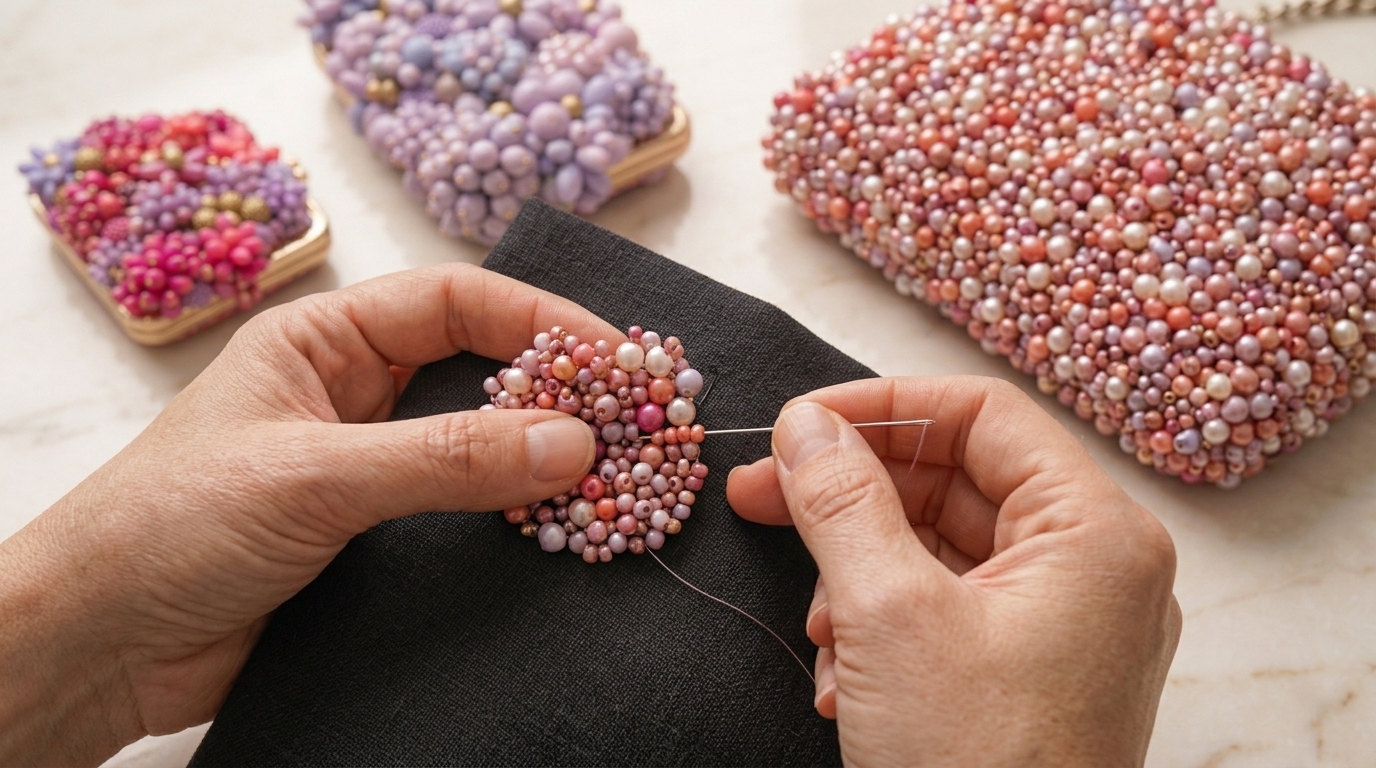
This is the most time-intensive stage. Artisans use a beading needle and strong thread (or wire, depending on the technique) to attach beads to a base fabric, mesh, or foundation panel, following the planned pattern one bead or one row at a time. Common hand-beading techniques include bead embroidery (stitching beads directly onto fabric) and loomed or off-loom beadweaving (creating a beaded fabric independently, which is later applied to the bag structure).
Tension control is critical here: too loose and the beadwork sags or shifts over time; too tight and the base fabric puckers, distorting the final shape.
4. Constructing the Bag
Once the beaded panels are complete, they’re assembled into the bag itself. This typically involves:
- Attaching a lining (to protect the reverse side of the beadwork and give the bag structure)
- Joining beaded panels to form the front, back, and sides
- Reinforcing high-stress points such as handle attachments and closures
- Adding hardware clasps, chains, or straps
5. Finishing and Quality Checks
The final stage involves trimming loose threads, checking for any beads that sit unevenly, reinforcing weak points, and confirming the bag holds its shape correctly. A well-finished handmade beaded bag should have no visible knots, no loose beads, and clean, even edges where the beadwork meets the lining or hardware.
Common Beading Techniques Used in Handmade Bags
| Technique | Description | Typical Use |
|---|---|---|
| Bead embroidery | Beads stitched directly onto a fabric base, following a drawn or charted design | Textured, pictorial, or dense floral motifs |
| Off-loom beadweaving | Beads woven together using only needle and thread, without a fabric base | Structured panels, geometric patterns |
| Loom beading | Beads woven on a small loom to create a flat beaded “fabric” | Uniform, repeating patterns |
| Bead accenting | Larger beads or beaded fringe added as decorative highlights | Closures, tassels, trim details |
Why the Process Takes So Long
A single handmade beaded bag can involve thousands of individual beads, each placed and secured by hand. Depending on the density and complexity of the design, the beadwork alone can take many hours to complete, before construction and finishing are even factored in.
This is one of the main reasons handmade beaded bags carry a different price point to mass-produced accessories: the cost reflects skilled labor and time, not just materials.
⚠️ COMMON MISTAKE: Assuming that a longer process automatically means a more valuable bag. Time invested matters, but so does technique a rushed hand-beaded piece with poor tension control can be less durable than a carefully made one with a simpler design. Craftsmanship quality and time invested go hand in hand, not one or the other.
How to Recognize Genuine Hand-Beading When Shopping
If you’re comparing beaded bags and want to understand what you’re actually buying, look for:
- Slight natural variation in bead placement a sign of hand-stitching rather than machine uniformity
- A clean interior finish, with lining that fully covers thread work and knots
- Secure, reinforced attachment points at handles and closures, where the most stress occurs
- Even tension across the beadwork, without puckering or sagging
These same considerations apply whether you’re browsing CHAMMAQ’s handmade beaded bags or comparing options from any artisanal accessories brand the craftsmanship fundamentals don’t change.
Why It’s Worth Understanding the Process
Knowing How handmade beaded bags are made is actually made turns “How handmade beaded bags are made” from a vague marketing term into something you can genuinely evaluate. It also reframes the bag itself not as a mass-produced accessory, but as a piece shaped, quite literally, bead by bead, by a person’s hands and attention.
If you’re exploring beaded bags for an upcoming occasion, understanding the craftsmanship behind them makes it easier to appreciate what separates a well-made piece from an ordinary one and to choose a bag that reflects that difference.
Explore CHAMMAQ’s handmade beaded bags collection to see this craftsmanship in the finished piece.